We have known since 2006 that when properly used, Montessori pedagogy gives children better opportunities than traditional education, and leads to superior results in terms of both academic performance and the enjoyment of children at school and the quality of their forms of socialization. This was explained by Angeline Lillard in a celebrated article published in the journal Science. Since then, the researcher has not stopped challenging us to take bolder steps in two directions: an application that she calls “more faithful” to Montessori’s ideas, and a bold expansion of the scope of these ideas. I have been meaning to write this text since July, but I am only able to do so now, because the discoveries that Lillard communicated at the International Montessori Congress in Prague have just been published in a new article.
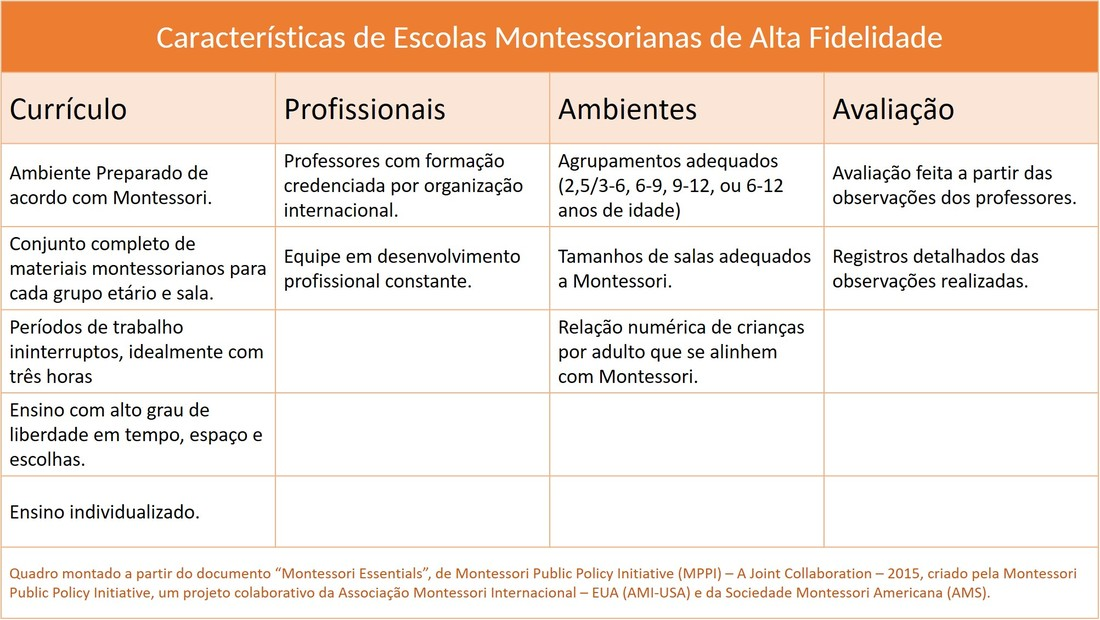
Before we continue: the study was conducted in Montessori schools linked to the International Montessori Association, recognized for applying Montessori with high fidelity. Below is a chart showing some of the characteristics of these schools.
In his new research, which lasted three years and involved 141 children in both traditional and Montessori schools, Lillard found that not only does Montessori provide better results for all children, but the method is also capable of closing the gap in academic performance between children from more and less affluent classes, as well as helping children who have not had the opportunity to develop their executive functions in their brains learn. This explains, at once, a real possible solution to inequality in education and makes clear one of the reasons why inclusion in Montessori actually works.
See the original full article here.
It is also worth watching Lillard’s talk, just before publication, below.
Now, let’s look at the results.
Differences between Montessori and Conventional schools
1. Academic Performance:
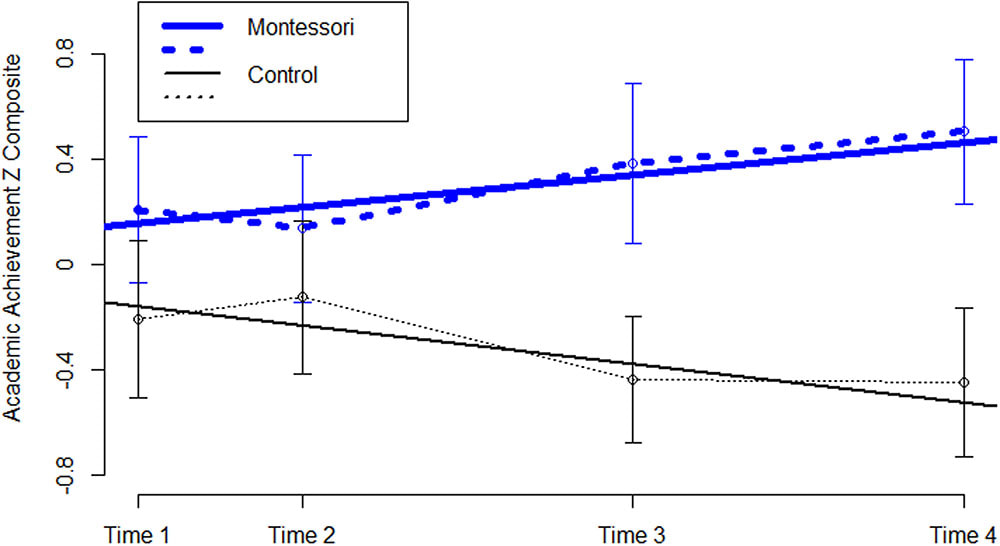
• Performance was the same at the beginning of the year;
• Montessori students progressed more quickly.
• Once isolated by gender, income, and Executive Function development, Montessori students continued to perform better.
• The major differences appeared after at least one to two years in the same mixed-age classroom at the Montessori school.
2. Social Intelligence:
• Similar performance in the early years between students in conventional and Montessori schools.
• Significantly different performance after one to two years in the Montessori school.
• Social intelligence developed more rapidly in children who attended Montessori schools.
3. Socialization Problem Solving:
• There was no difference in this study in socialization problem solving between children who attended Montessori schools and children who attended conventional schools.
4. Executive Function Development:
• There was no strong evidence in this study that Montessori schools led to better Executive Function development.
5. Mastery Orientation:
• At the beginning, there were no differences in the enjoyment of trying new challenges between children in Montessori schools and those in conventional schools.
• Children in Montessori schools showed much more willingness to try new challenges after one or two years in Montessori school, with explanations such as “I want to try because I think I can do it.”
6. Enjoyment of Being at School:
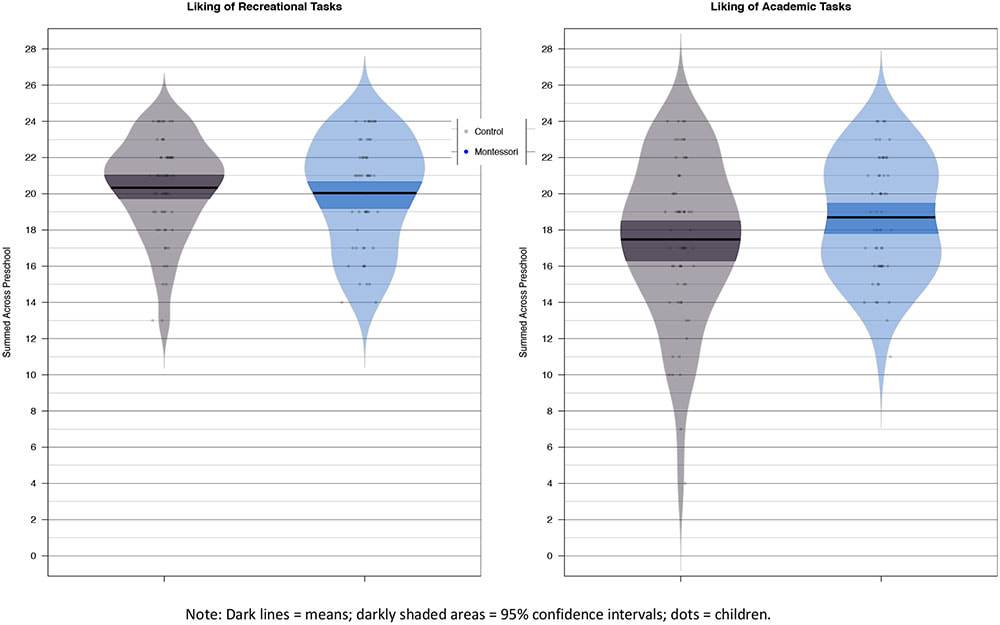
• Montessori children feel more enjoyment of being at school.
• This indicates that their superior performance does not come at the expense of losing the enjoyment of being at school and doing school activities. (This confirms results from 2006, including).
• The graph below shows averages, minimums, and maximums for measures of enjoyment involving recreational and study activities in conventional (gray) and Montessori (blue) schools.
7. Creativity
• Throughout the study, there were no differences in the development of creativity between the average children in Montessori and conventional schools.
Now, in my opinion, comes the most interesting part of the study, in which Lillard demonstrates that Montessori can bridge the gap that would exist between children of different social classes in school.
Performance Differences Involving Social Class and Executive Functions
1. Differences Between Montessori and Conventional Schools
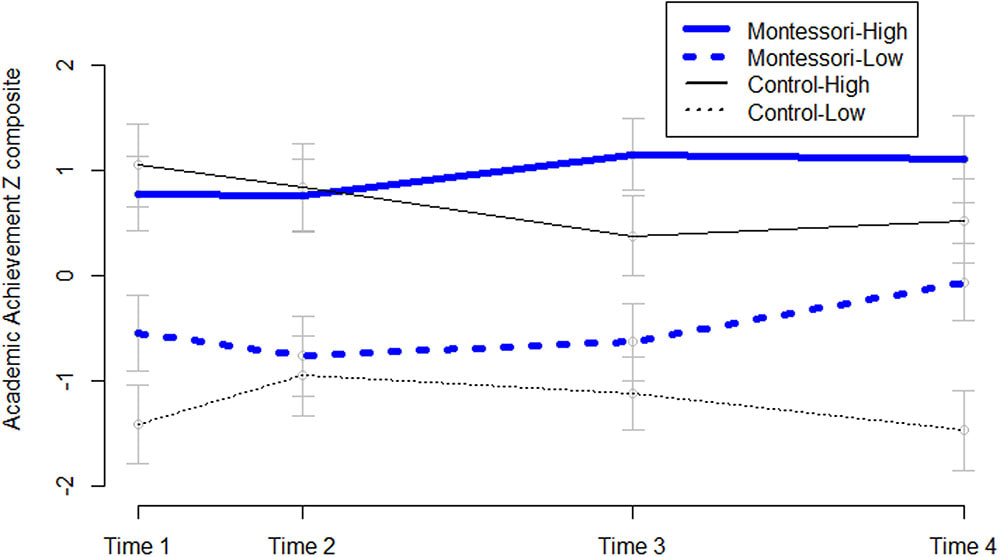
• Children in Montessori schools performed much better academically than children in conventional schools, regardless of social class.
• When isolated by social class, this academic performance continued to be disparate. Children with much lower family incomes who were in Montessori schools performed better than children with lower family incomes in conventional schools.
2. Differences (or not) between children with higher and lower income families in Montessori
• At the beginning, there was a marked difference between children with higher and lower family incomes, even in Montessori schools. This was true for the entire first year.
• In the second year, this difference had reduced so much that it became statistically insignificant.
• In the third year, it had reduced again, by another 33%.
• The difference between children with higher and lower family incomes in the conventional schools involved in the study was statistically much greater than that found among children in Montessori schools.
• The children with higher family incomes and enrolled in Montessori schools performed best in the study, but the difference between the children with lower family incomes in Montessori schools and those in conventional schools was striking, and the Montessori children performed much better at the end of preschool.
3. Performance Differences involving Different Developments of Executive Functions
• At baseline, better development of executive functions was indicative of better performance in both Montessori and conventional schools.
• Across the measures, development of executive functions continued to be an important predictor of performance for children in conventional schools.
• In Montessori schools, development of executive functions was not shown to be a relevant indicator of performance.
• Children in Montessori schools performed better overall, and this included children with poorer development of executive functions.
• Reinforcement programs aimed at improving development of executive functions are irrelevant in Montessori schools to equalize performance.
There is a final section of the study on differences between public and private schools, conventional schools, compared to Montessori schools involving children with all levels of family income and development of executive functions. It is less interesting to us because the differences between public and private schools in the context studied are, in themselves, very different from the differences we found here. Even so, the results were:
1. Academic performance
• A marked difference in favor of Montessori, compared to public and private schools.
2. Social intelligence
• Significant differences between Montessori and public schools, but not between Montessori and private schools.
3. Executive functions
• Significant differences between children who went to public Montessori schools and children who went to conventional schools, also public.
These are the results. Lillard then goes on to discuss the possible reasons for these results, which no longer involve the same research, but a good bibliography researched both in the specific scientific field of cognitive psychology and with regard to Montessori. In the future, we may write another text, detailing the discussion that concludes the article.
For us, at the Montessori Education Center of São Paulo, your comments are important. What do you see in your school regarding what Lillard studied? Has implementing a more faithful application of Montessori thinking benefited your children in a noticeable way? When you receive children from other schools, how have they evolved in Montessori over the years? I would be delighted to read what you have to add to our discussion.